

Weaving a Web of Belonging
THE JOURNEY
From FACES SPACES PLACES
to
The Belonging Mattering Liminality (BML) Framework
THE MAP
In Weaving a Web of Belonging (Cherry, 2025) I set out FACES SPACES PLACES as a simple approach to help practioners consider belonging. This developed out of my research with care-experienced adults, answering a question about how belonging can be made sense of; where belonging is made and where it is broken. The answer, I found, was in relationships, in structures and in the physical and symbolic places that hold a life. Rarely in only one of them. Belonging is plural. That is why I talk about a web rather than this misplaced idea about one attuned adult. A web holds when one thread breaks.
THE FIVE DIMENSIONS OF BELONGING
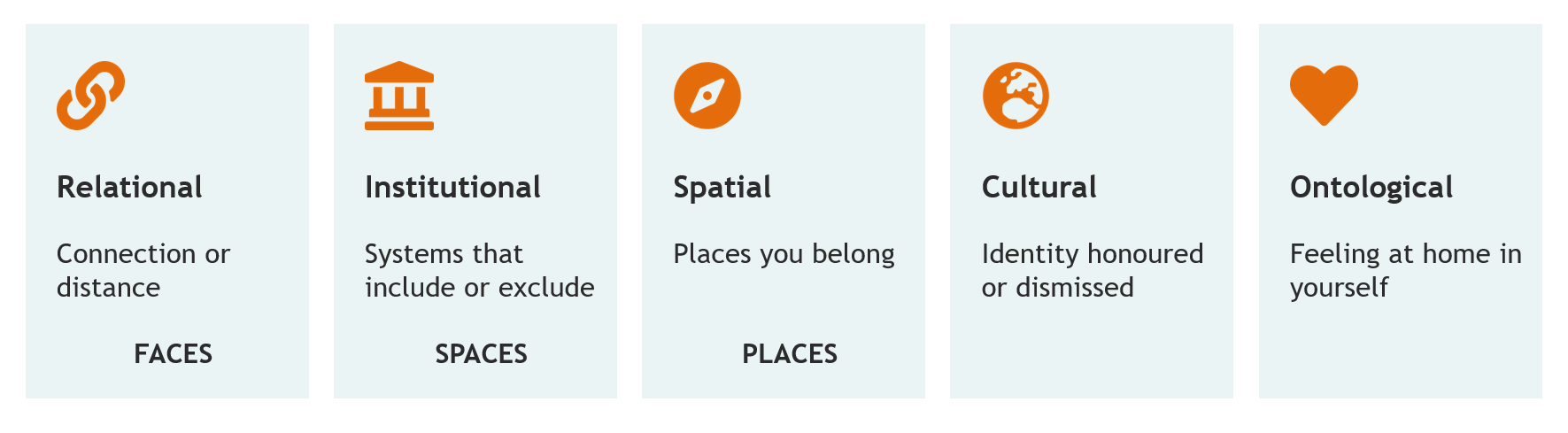
As the BML framework grew, belonging itself needed a fuller account than three domains could give. FACES, SPACES and PLACES carried into it as three of FIVE dimensions. FACES is the relational dimension, where we find connection or distance, SPACES is the institutional dimension, the systems that include or exclude and PLACES refers to the spatial dimension, the places we can belong. The next two dimensions followed with the cultural dimension asking whether a person’s identity is honoured or dismissed and the ontological dimension as something that sits beneath all the others. It is about ‘feeling at home in yourself’. Belonging is cultivated out there, in places, people, cultures and systems. But it is lived within us.
REMAINING QUESTIONS
A map can show a person’s world thread by thread without telling you whether that person counts to anyone in it. For example, a young person can have adults around them, a school place and a roof and feel as though they don’t belong anywhere. That young person is safe, supervised and unbelonging. Mattering gave me the language for what was missing (Rosenberg and McCullough, 1981; Flett, 2018) moving the question from “do I belong here?” to “do I matter to anyone here?”
A map, while important and necessary, also assumes a stillness that simply doesn’t exist for many. For children in care for example FACES leave, SPACES close their doors and PLACES are lost overnight. Much of the harm sits not inside any one dimension but in the constant movement which so characterises the experience of being in care. For those who are displaced, who have fled war and conflict, whose town is now rubble, stillness is a fantasy. The concept of liminality, drawn from van Gennep (1909/1960) and Turner (1969) names that threshold and asks what happens to a person, who is there for that person, while they are living it.
IN CONCLUSION
We must start with belonging because that is our fundamental human need (Baumeister and Leary, 1995). We will find somewhere to belong regardless of whther that place of belonging is good for us or not! Traffickers, the far right, those who exploit, they know. They are masters in human psychology. The BML framework is a road map that can offer protection merely by making visible what so goes often un-noticed.
The journey has brought the five dimensions which tell us where and how belonging is lived. BML asks, in each of them, whether belonging is offered, whether the child matters there and what happens on the way in and on the way out. The map is the ground that BML stands on.
To learn more about Weaving a Web of Belonging and Creating Spaces Where Every Child and Young Person Thrives: Introducing the Belonging, Mattering and Liminality Framework please head to the Book Shop.
“Having attended Lisa’s training in the past and followed her work closely, when we decided on belonging as a theme for our practice week, I knew Lisa would be the best person for our keynote session. Lisa was able to provide her wealth of knowledge, expertise and wisdom at delivering a keynote speech that resonated with practitioners from education/skills and social care- which evidenced the need to work together to promote the belonging of children we work alongside and the value of bringing together our knowledge and expertise to ensure the child’s journey is at the centre of our work. In addition to supporting our reflections in how we work alongside family members and children in ways which reduces shame, blame and fosters principals of positive regard, love and care.”
Louise Spragg
Principal Social Worker
Telford & Wrekin Council