
The children the system makes visible; stigma, liminality and alternative provision
This post is written drawing from the contents of Episode One of my latest podcast series on Stigma. It is a six-part series and Episode One is a conversation between myself and Dr Craig Johnston.
Season 8 of the Trauma Resonance Resilience Podcast opens with the question; what is stigma? More importantly, what does it do structurally to the children and young people served by our systems. My entry point was Imogen Tyler's (2020) work on stigma (a must read) as a machinery of inequality, which also arose during my doctoral research. My guest for this opening episode was Dr Craig Johnston, senior lecturer in Criminology at the University of the West of England, who spent twenty-five years as a practitioner before turning to research and who attended alternative provision himself after being excluded from school, as did I. That shared ground shaped the conversation.
What alternative provision is and why it is contested
Alternative provision, as Craig defines it, is any educational space outside the mainstream classroom, from the pupil referral unit at one end to forest schools and home education at the other. Around four to five per cent of the school population is educated within it and roughly seventy-nine per cent of those young people carry a defined label of some kind, whether free school meals, disability or special educational needs. Craig's new book, Learning on the Margins (Johnston, 2026), maps this terrain through Bourdieu's capital theory, asking how social, cultural and material resources are mobilised in ways that can sustain inequality even while opening small spaces for agency.
Until 2019, alternative provision was largely framed through the language of forgotten children, a bad space that children should not be in. After 2019 it became, almost overnight, a space of flexibility and opportunity. Both narratives can be true and neither resolves the harder question that Craig kept returning to; if the children educated there do not have access to the same resources as their mainstream peers, at what point does provision become segregation?
The liminal student
Regular listeners will know that liminality, alongside belonging and mattering, forms one third of the framework at the heart of my own work (Cherry, 2025). So I asked Craig directly whether he saw a relationship between stigma and liminality. His answer was sharp. The moment a child is moved from mainstream schooling, they become something in between. Are they still a student? Are they a young person, a label, a case? They are removed from the very settings that ground them in being a student at all; the social life, the cultural knowledge and the ordinary tensions of belonging among peers. In Turner's (1969) terms, they are betwixt and between, no longer who they were and not yet anything the system has imagined for them.
And here is where the two concepts lock together. Liminal space, in its original anthropological framing, assumed ceremony masters, people whose role was to hold you through the passage. When nobody holds the threshold, the need to belong and to matter does not disappear (Baumeister & Leary, 1995; Flett, 2018). It goes looking. We both noted how deliberately certain political narratives now target people in precisely those unheld liminal spaces. My own experience of alternative provision in the 1980s was of being ‘held’ until legal school leaving age, at which point I left with nothing. There was no becoming on offer. That absence is not incidental to stigma. It is where stigma takes hold.
Visible, fixed, blamed
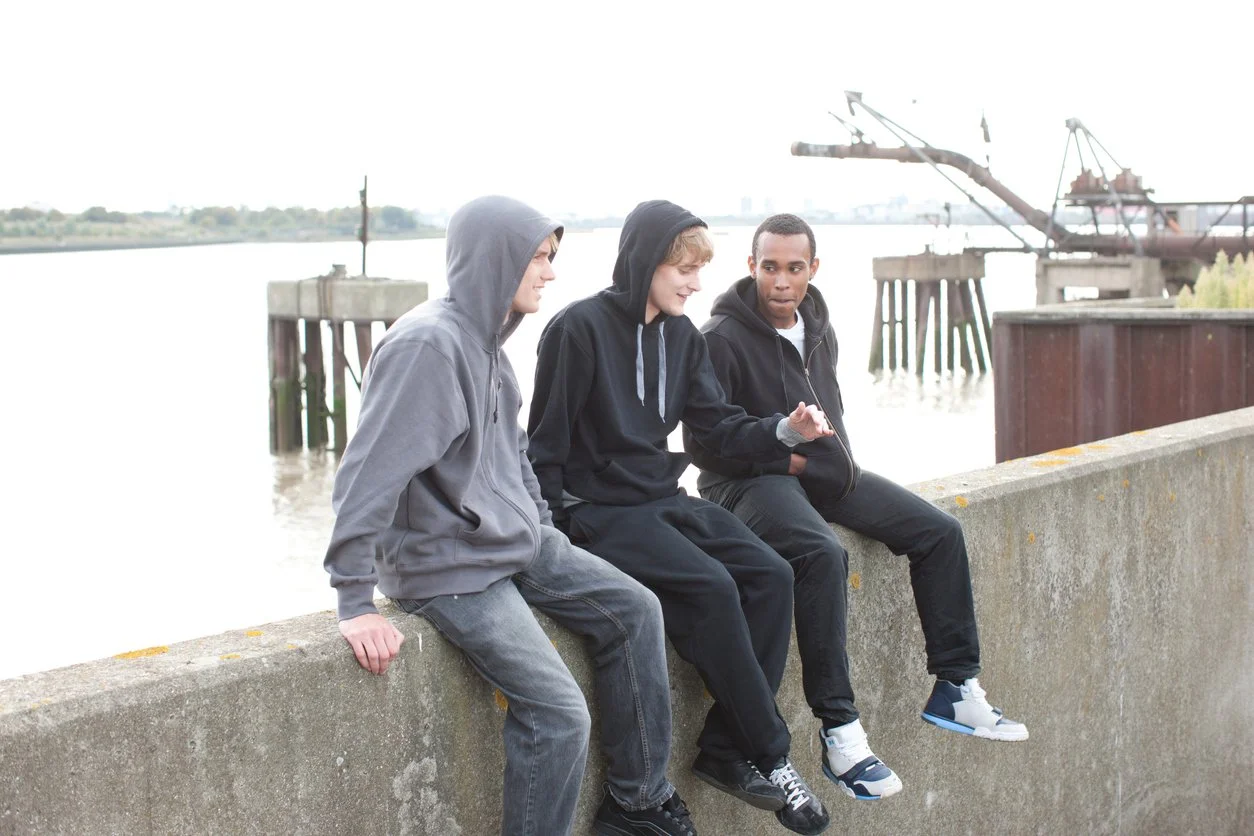
I asked Craig how stigma operates differently once a child is inside alternative provision compared with mainstream, where a struggling child already experiences stigma acutely. It becomes visible and it becomes fixed. Placement requires a reason, the reason requires a label and the label makes the child manageable. This is Goffman's (1963) master status at work, a single attribute that comes to stand for the whole person, trailing assumptions of deficit that are overwhelmingly psychological and overwhelmingly individual. The child is to blame and where the child is not, the family is and predominantly refers to the mother.
This is the pattern I see across every sector I work in and it is why ‘language’ sits at the centre of my practice (Cherry, 2021). At risk. Vulnerable. Hard to reach. Lacking aspiration. Craig calls this disciplinary power, a terminology set in stone around children that restricts who they think they are and who they might become. His earlier ethnographic work with Simon Bradford showed how disabled working-class boys in one alternative provision built revalorised but still stigmatised identities inside a space of failure (Johnston & Bradford, 2019) and how the young men on the margins of provision drew more sustenance from their own friendship networks than from the professional interventions designed to rescue them (Johnston & Bradford, 2023). Their paper Other Lives studied the children who were referred to provision but not attending, which Craig argues is the actual core of alternative provision, the lives research rarely reaches.
The self and the social
When Craig is referring to stigma, he means the Goffman inheritance, labels stuck to the self, shame, blame, discrimination, stereotype and also the structural turn that Tyler (2020) represents, which is of stigma as something produced, embedded in how societies organise welfare, education and worth. His insistence was that the self and the social cannot operate without each other. It reminded me of the word resilience; a word that gestures at resources while quietly locating the deficit in the individual (Cherry, 2022). Stigma is doing the same work when we treat it as a description of a person rather than an operation of a system.
Craig also voiced a worry I share, that we are living through a kind of collective amnesia about critical theory. Ideas like stigma and belonging are being reinvented without their historical grounding, smoothed into something rosy and warm. Belonging is not new. But in a segregated space, an appeal to belonging can simply reinforce the shame and the stereotype it claims to heal. This is exactly why I hold belonging and mattering together with liminality rather than as separate entities (Cherry, 2025).
Working class boys and the here and now
We spent time on the group most overrepresented in alternative provision; working class boys, disproportionately disabled. Craig, a working class academic who co founded a network to give voice to that contradiction in terms, was careful to refuse the moral panic. Young working class men are not a monolith and the assumptions loaded onto them, hysterical, psychological, fearful, tell us more about the observers than the observed. His reading of the Netflix drama Adolescence was a practitioner's reading; the moment the practitioner raised her voice and withheld the boundaries of the work, she instigated the very behaviour that reinforces the stereotype of the angry working class boy and the drama never held her accountable for it.
What these young people are doing, Craig argued, is making rational choices in the here and now, based on what they know and what is actually around them. Why pay eighty thousand pounds for a degree when that money buys two flats in Dundee? Why stay for two more GCSEs in a town with no visible route out? These are not failures of aspiration. They are calculations made inside constrained fields and until we take the constraint seriously rather than pathologising, we will keep writing children up as the problem.
Where stigma goes next
I ended by asking what questions researchers, policy makers and practitioners need next. Craig's answer was the digital world, a space most academics of our vintage still dismiss and one where stigma is already playing out dramatically. How do young working-class people recognise themselves in online spaces? What capitals and resources are actually being redistributed there and to whom? Given that online provision is itself now a form of alternative provision, complete with the marketisation of children's education, the question is urgent. If you are looking for a doctoral project, stigma and digital communities through a Bourdieusian lens is sitting there waiting and Craig would make a fine supervisor.
Stigma names what gets attached. Liminality names where it attaches, in the unheld space between who a child was and who they might become. Systems produce that space and then blame the children standing in it. The work, as ever, is to change the conditions, not the children.
You can listen to the full episode with Dr Craig Johnston wherever you get your podcasts. His book Learning on the Margins: Alternative Provision, Capital and Youth Justice is out now with Palgrave Macmillan.
References
Baumeister, R. F., & Leary, M. R. (1995). The need to belong: Desire for interpersonal attachments as a fundamental human motivation. Psychological Bulletin, 117(3), 497–529. https://doi.org/10.1037/0033-2909.117.3.497
Cherry, L. (2021). Conversations that make a difference for children and young people: Relationship-focused practice from the frontline. Routledge.
Cherry, L. (2022). The brightness of stars: Stories from care experienced adults to inspire change (3rd ed.). Routledge.
Cherry, L. (2025). Weaving a web of belonging. Routledge.
Flett, G. L. (2018). The psychology of mattering: Understanding the human need to be significant. Academic Press.
Goffman, E. (1963). Stigma: Notes on the management of spoiled identity. Prentice-Hall.
Johnston, C. (2026). Learning on the margins: Alternative provision, capital and youth justice. Palgrave Macmillan. https://doi.org/10.1007/978-3-032-25989-9
Johnston, C., & Bradford, S. (2019). Alternative spaces of failure: Disabled 'bad boys' in alternative further education provision. Disability & Society, 34(9–10), 1548–1572. https://doi.org/10.1080/09687599.2019.1601070
Johnston, C., & Bradford, S. (2023). Other lives: Relationships of young disabled men on the margins of alternative provision. Disability & Society. Advance online publication. https://doi.org/10.1080/09687599.2023.2209278
Turner, V. (1969). The ritual process: Structure and anti-structure. Aldine.
Tyler, I. (2020). Stigma: The machinery of inequality. Zed Books.
