
Belonging in a Time of Rising Need
What the Data Tells Us About Children’s Lives in 2025
Across the last fifteen years, the lives of children and young people in the United Kingdom have changed in profound and measurable ways. Why am I choosing to focus on the last 15 years? There are two reasons and the first is political. The Tory/Lib Dem coalition government came into power in 2010 and began a 14 year slaughter of our public services which means that children growing up in this time period rather than the 15 years prior, will have had a very different experience of childhood. Secondly, children born in 2010 will be taking their GCSE’s this year, having lived through the impact of the ideology of austerity, Brexit, COVID-19, unregulated timelines on devices and a rise in far right politics. While public debate focuses on individual behaviour, resilience or family circumstances, the data tells us a different story; one of systemic pressures, rising need and environments struggling to keep pace with the complexity of children’s lives. When viewed together, the data on special educational needs, attendance, exclusion, mental health and poverty reveal a landscape that demands relational, trauma‑informed and context‑sensitive responses.
Belonging
Recent analysis of UK PISA data by Palikara, Bonneville‑Roussy, and Allen (2025) found that school‑level factors accounted for 39 per cent of the variance in students’ sense of belonging, while individual characteristics such as gender, socioeconomic status and motivation explained only 6 per cent. This is a striking finding. In educational research, school‑level variance is typically modest; a figure approaching 40 per cent suggests that belonging is shaped far more by the environment than by the what the individual child brings into the school. In other words, belonging is not something children bring with them, it is something schools cultivate.
Special Educational Needs
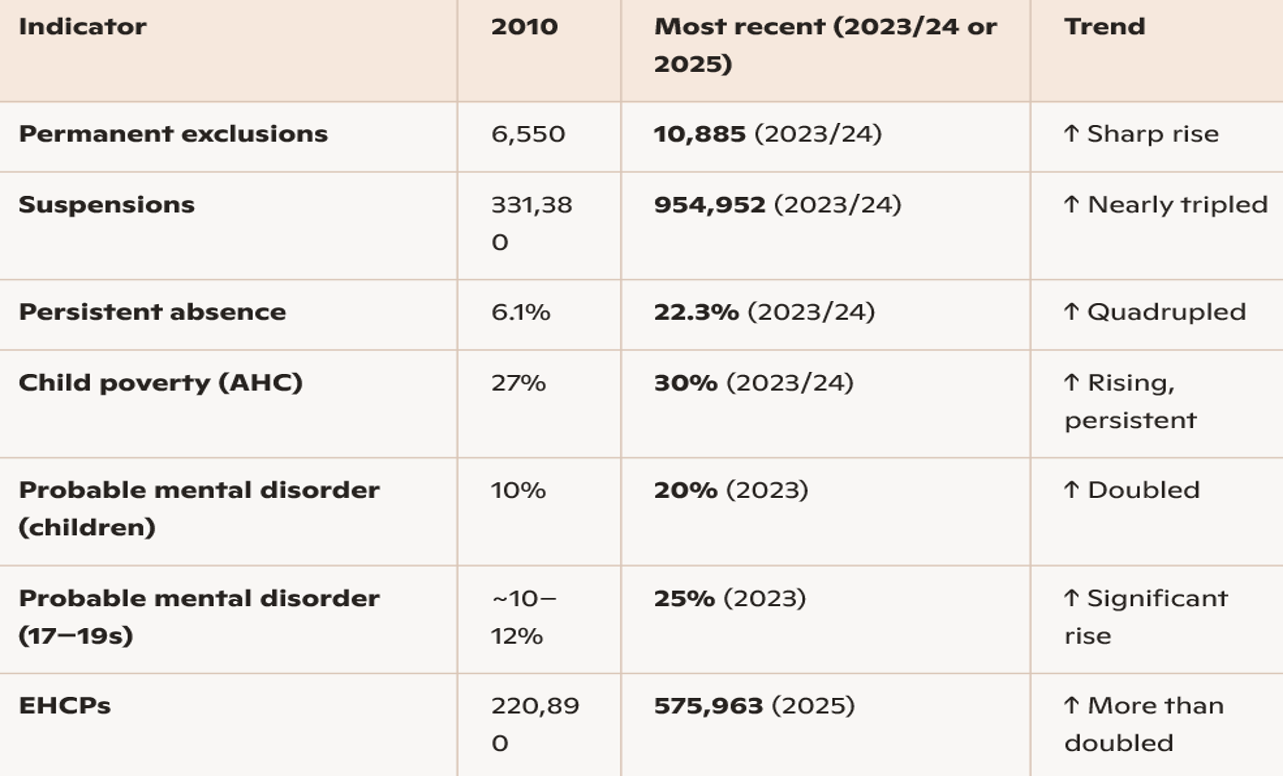
In 2010, approximately 1.69 million pupils in England were identified as having special educational needs (Department for Education [DfE], 2010). In 2025, the number remains similar, around 1.76 million, but the profile has shifted. The number of pupils with statutory plans has more than doubled, from 220,890 statements in 2010 to over 480,000 Education, Health and Care Plans (EHCPs) in 2025 (DfE, 2024). This indicates not simply more need, but more complex and enduring need, placing significant pressure on schools and local systems.
Exclusion
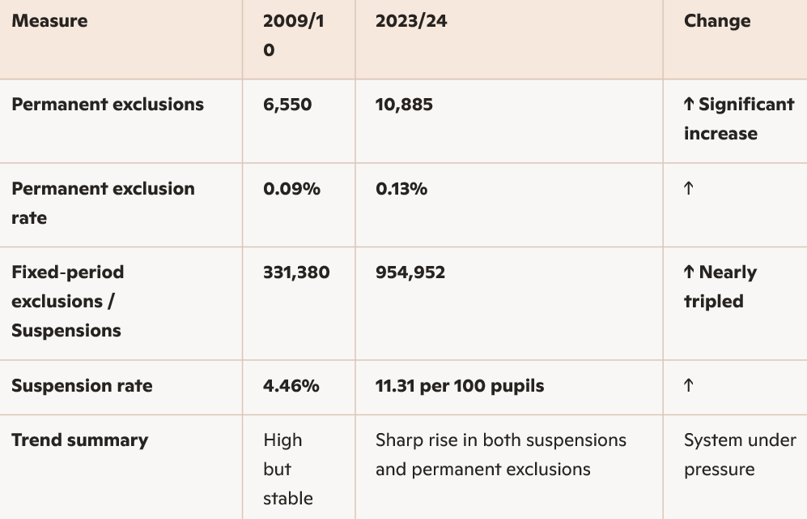
The latest DfE exclusions data (2023/24), published in July 2025, shows a sharp and concerning rise. Permanent exclusions have increased to 10,885 (yes you read that right), the highest figure in more than fifteen years. Suspensions have also surged to 954,952 incidents, approaching one million in a single academic year. This represents a substantial escalation in the use of exclusionary practices. Rather than indicating reduced need, these patterns suggest a system under significant strain. Schools appear to be relying more heavily on short‑term exclusion, often in response to behaviour that may be rooted in unmet need, distress, or disrupted belonging.
Attendance
School attendance has undergone one of the most significant changes in the education landscape. In 2010, persistent absence stood at 6.1 per cent (DfE, 2011). By 2023/24, it had risen to 22.3 per cent (DfE, 2024). ‘Severe absence’, attending 50 per cent or less, has also doubled. These are not marginal fluctuations and reflect broader social, emotional and environmental pressures that shape children’s capacity to engage with school.
Mental Health
Perhaps the most concerning trend is the rise in mental health difficulties among children and young people. In 2010, around 10 per cent of children aged 5–16 met the criteria for a diagnosable mental disorder (Green et al., 2005; McManus et al., 2009). By 2023, this figure had doubled to 20 per cent for children aged 8–16, and reached 25 per cent for young people aged 17–19 (NHS Digital, 2023). Girls aged 17–19 show the highest prevalence, with around 30 per cent experiencing a probable mental disorder. These increases align with rising levels of distress, anxiety and depression reported across multiple national datasets. I should also add the caveat that there are many current and ongoing discussions regarding the medicalising and therefore individualising of very normal responses to distress and plonking the word disorder at the end of everything being experienced, warrants a debate outside this post.
Poverty: Deepening and Widening
Child poverty remains one of the most powerful predictors of educational and well-being outcomes. In 2010, 3.6 million children were living in poverty after housing costs which is around 27 per cent of all children (Department for Work and Pensions [DWP], 2011). By 2023/24, this had risen to 4.3 million, or 30 per cent (DWP, 2024). Deep poverty, families far below the poverty line, has also increased. Poverty interacts with every other trend described here; attendance, mental health, exclusion and belonging.
A Systemic Story, Not an Individual One
When these datasets are viewed together, a clear narrative emerges:
• Children’s mental health needs have doubled.
• Poverty has increased and deep poverty has intensified.
• Persistent absence has quadrupled.
• Suspensions have risen.
• The complexity of SEND has grown.
What Now?
These are not isolated issues. They are interconnected expressions of a system under strain. They tell us that children have not changed; the conditions in which they are growing up have. And if belonging is so powerfully shaped by the environment, then the work of schools, communities and policymakers must focus on creating relational, inclusive and emotionally literate spaces where children can thrive.
Belonging is not a soft concept. It is a measurable, protective factor that sits at the heart of children’s wellbeing, engagement, and outcomes. In a time of rising need, it is also one of the most powerfullevers we have.
The Books - The Website - The Podcast
References
Department for Education. (2010). Special educational needs in England: January 2010. DfE.
Department for Education. (2011). Pupil absence in schools in England: 2009/10. DfE.
Department for Education. (2024). Pupil attendance in schools in England: 2023/24. DfE.
Department for Education. (2025). Special educational needs in England: January 2025. DfE.
Department for Education. (2025). Suspensions and permanent exclusions in England: 2023/24. DfE.
Department for Work and Pensions. (2011). Households below average income: 2009/10. DWP.
Department for Work and Pensions. (2024). Households below average income: 2023/24. DWP.
Green, H., McGinnity, Á., Meltzer, H., Ford, T., & Goodman, R. (2005). Mental health of children and young people in Great Britain, 2004. Palgrave Macmillan.
McManus, S., Meltzer, H., Brugha, T., Bebbington, P., & Jenkins, R. (2009). Adult psychiatric morbidity in England, 2007. NHS Information Centre.
NHS Digital. (2023). Mental health of children and young people in England. NHS Digital.
Palikara, O., Bonneville‑Roussy, A., & Allen, K. (2025). School belonging and its predictors: Analysis of UK PISA data.
